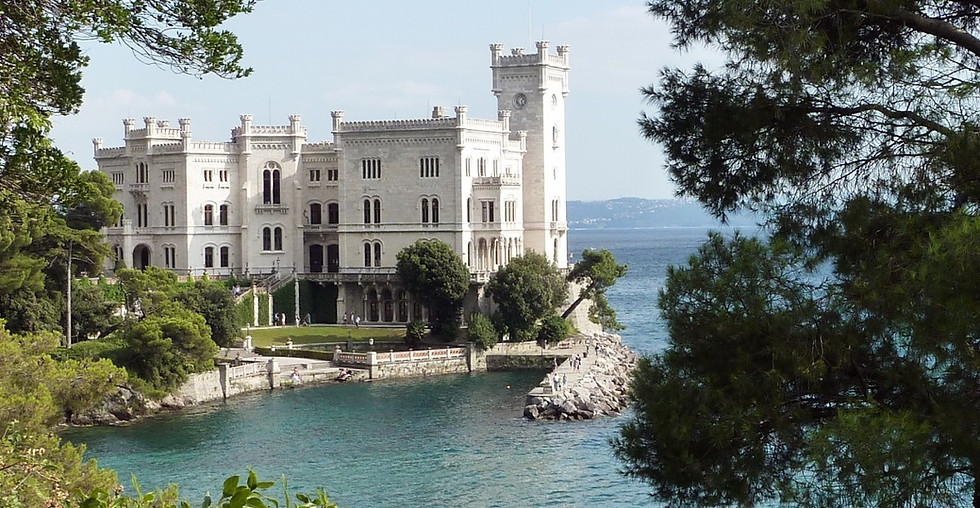
A BRIEF HISTORY OF TRIESTE
WHAT MAKES IT UNIQUE?
Nestled between the Adriatic Sea and the limestone hills of the Carso, Trieste is a city like no other. Its unique position at the crossroads of Latin, Slavic, and Germanic cultures has shaped a history filled with conflict, coexistence, and creativity. From Roman antiquity to its time as a vital port of the Austro-Hungarian Empire, Trieste’s story is one of transformation and resilience. In this article, we’ll explore the rich and complex history of Trieste, and discover what makes it truly unique among Italian cities.
Ancient Beginnings: Roman Origins and Crossroads of Civilizations
Trieste’s recorded history begins in antiquity, when it was known as Tergeste, a Roman colony established in the 1st century BCE. Thanks to its strategic location on the Adriatic coast, the settlement quickly became a hub for maritime trade and military activity. Roman remains, including the ancient theatre and segments of city walls, still remind visitors of this era.
But Trieste’s history is not just Roman: it has long been a gateway between East and West, absorbing cultural influences from Illyrians, Venetians, and early Slavic populations. This position as a cultural crossroads laid the groundwork for the city’s later diversity.


Medieval and Habsburg Influence: From Autonomy to Empire
During the Middle Ages, Trieste maintained a degree of autonomy under the protection of the Holy Roman Empire, while also fending off incursions from the nearby Venetian Republic. In 1382, the city voluntarily placed itself under the protection of the Habsburg dynasty, marking the beginning of a centuries-long relationship with the Austrian crown.
Under Austro-Hungarian rule (particularly from the 18th to early 20th century), Trieste blossomed. It was declared a free port in 1719, igniting a period of rapid economic and urban development. The city became the empire’s most important maritime outlet, attracting a vibrant mix of ethnic groups: Italians, Slovenes, Austrians, Greeks, Jews, and others, all contributing to its cosmopolitan character.
The elegant neoclassical and Viennese Secessionist architecture seen today in the city center. such as the palazzi along the Grand Canal and Piazza Unità d’Italia, owes much to this golden age.
Click here to discover The Influence of Austria-Hungary on Trieste’s Architecture & Culture.
The Tumultuous 20th Century: Wars, Borders, and Identity
The 20th century brought upheaval. After World War I, Trieste was annexed to Italy, a transition that brought political tension and a period of Italianization. During World War II, the city endured German occupation, Allied bombing, and the horrors of the Risiera di San Sabba, a Nazi concentration camp located within city limits.
Do you want to know more? Read our article Fascist & WWII History in Trieste: Key Sites and Events.
Following the war, Trieste became a Free Territory, administered by the Allies and Yugoslavia, before returning to Italian control in 1954. These turbulent decades shaped the city’s complex identity: at once Italian and international, Mediterranean and Central European.


What Makes Trieste Unique Today?
• Multicultural Heritage: Trieste’s layered identity is still visible in its languages, religious buildings, and cuisine. Churches, synagogues, and temples stand side by side, reflecting centuries of tolerance and coexistence.
• Architectural Diversity: Roman ruins, Habsburg palaces, modernist buildings – Trieste’s architecture tells the story of its past in every street.
• Geopolitical Significance: Located near Slovenia and Croatia, Trieste remains a bridge between Western and Eastern Europe, and a hub for shipping, science, and diplomacy.
• Intellectual Legacy: The city inspired figures like James Joyce, Italo Svevo, and Umberto Saba, and it continues to cultivate a rich literary and academic scene.
Trieste’s history is not linear, but layered and multifaceted, shaped by empires, migrations, and cultural exchanges. It is this complexity that gives the city its soul. A place where East meets West, where every building and street tells a story. Whether you’re a history buff, a cultural traveler, or simply curious, Trieste invites you to step into a past that is still very much alive.